
Process water treatment in clinics
A system for the production of demineralised water, which is used as process water in treatment, is a combination of several components. In order to optimise these work processes, the DGSV advises stricter limit values. Many hospital management teams and AEMP managers are already adapting their process water production to these new requirements. This has several advantages. In addition to legal certainty, this results in direct cost savings.
Damage to medical devices is minimised:
Limescale deposits, corrosion and silicate deposits, which are visible signs of poor process water quality in instruments and devices, are observed much less frequently. This helps to increase service life and reliability and reduce the need for expensive repairs or replacement purchases. In addition, the efficiency of sterilisation and cleaning processes is improved, which in turn reduces operating costs and increases the safety of patient care.
The maintenance set consists of: EX 50 - 248 filter cartridge filter fineness 50µm, length 248mm ITP activated carbon filter cartridge (poured) GAC-10. filter fineness 20µm, length 248mm Area of application: chlorine absorption Membrane filter element GR25. Filter fineness absolute 0.2µm, length 10’ Retention 99.98%. O-ring for filter cup ES Slim Line. Membrane 3012 for Diluat under-sink system. O-ring for pressure pipe 3012. MB A6K4 ‘disposable quality’ mixed bed resin (no VOC) Mixture resin: anions: 60% - cations 40%. Frequently Asked Questions For which water conditions is this maintenance package intended? For regions with high water hardness above 14°dH. What is the maintenance package used for in an under-sink system? It ensures the reliable operation of the system over several maintenance intervals. Which filter stages are included in the package? A pre-filter, an activated carbon filter and a high-precision membrane filter. What is the role of the pre-filter (50 µm)? It removes coarse particles such as sand or rust from the water. What is the function of the activated carbon filter? The activated carbon filter reliably removes dissolved chlorine and organic impurities from the water. Thanks to the large porous surface area of the activated carbon, these substances are effectively bound and retained by adsorption. At the same time, the filter helps to reduce unwanted odours and tastes. A key function is the dechlorination of the water: free chlorine and chlorine-containing compounds are effectively filtered out. What does the membrane filter in the set do? It ensures very fine filtration with a high retention rate of 99.98%. Why is mixed-bed resin included? Mixed-bed resin helps to stabilise water quality by removing dissolved ions from the water. Over time, however, its ability to bind ions diminishes. Depending on the water flow rate and the hardness of the water, the absorption capacity for minerals, salts and silicates is gradually exhausted, causing the resin’s effectiveness to diminish and making replacement necessary. Which seals are included in the maintenance pack? O-rings for the filter cup and pressure pipe to ensure a secure seal. What is the 3012 membrane used for? It is an essential component of water treatment in the under-sink system. As a high-performance water filter, it ensures effective water treatment. For which maintenance intervals is the set suitable? For 6, 18 and 30 months, depending on usage and load.
The maintenance set consists of: EX 50 - 248 filter cartridge filter fineness 50µm, length 248mm ITP activated carbon filter cartridge (poured) GAC-10. filter fineness 20µm, length 248mm Area of application: chlorine absorption Membrane filter element GR25. Filter fineness absolute 0.2µm, length 10’ Retention 99.98%. O-ring for filter cup ES Slim Line. Frequently Asked Questions For which water conditions is this maintenance pack designed? For regions with low water hardness below 14°dH. What is the maintenance pack used for in the under-sink system? It ensures the safe operation of the system over defined maintenance cycles. Which filter stages are included in the set? A pre-filter, an activated carbon filter and a high-precision membrane filter. What is the function of the 50 µm pre-filter? It removes coarse particles such as sand or rust from the water. What does the activated carbon filter do in the system? It reduces chlorine and organic substances in the water. What performance does the membrane filter offer? It filters very finely at 0.2 µm with a high retention rate of 99.98%. Which seal is included in the maintenance pack? An O-ring for the filter cup ensures a secure seal. What maintenance intervals is the set designed for? For 6, 18 and 30 months, depending on operating conditions. How does this pack differ from the version for hard water? Due to the lower water hardness, fewer parts need to be replaced.

Our Neomeris conductivity cell with 12mm connection is used for the determination of the electrical conductivity in aqueous solutions. Inside the T-piece is the two-electrode measuring cell without temperature compensation. The installation is easy and fast due to the John Guest connectors. We recommend the use of the product in the fields of distillate, condensate, ultrapure water as well as fully demineralized water. Technical data Material Housing: POM T-piece John Guest ½" Material electrodes: V4A 4571 Cell constant: C = 0.1 +-5% Max. operating pressure: 6 bar Max. operating temperature: 60°C Electrical connection: - brown electrode, outer sheath - white Electrode, inside - blue: shieldCable length: 2.5 meters

MB A6K4 is a high capacity mixed bed ion exchange resin consisting of a mixture of strongly basic anion resin and a strongly acidic cation resin for direct water purification.The conductivity is about 0.06 µm/cm.Suitable for use in non-regenerable cartridges, high efficiency deionisation for silica removal and ultra pure water applications.Packed in 25 litre bagsPolymer matrix: gel polystyrene cross-linked with DVB.Ionic form, as supplied: H+ / OH-Physical shape and appearance: Spherical beadsSphericity: Min. 95%Particle size range (US Standard Screen): 1.25 - 0.315mm, wet.Particle size: +1.2mm < 5% ; -0.3mm < 1%Water retention H+: 45 - 50%Water retention OH-: 53 - 60%Shipping weight (approx.): 700-740 g/lMax. Temp. non-regenerative: 100°CMax. Temp. regenerative: 60°CpH-value range: 0-14Recommended operating conditions:Minimum bed depth should be 0.6m (24")Service flow rate should be 20-60 BV/hourProlonged exposure to strong oxidising agents such as chlorine, hydrogen peroxide and concentrated nitric acid will deteriorate the structural backbone of the resin and should be avoided.Mixture Resin:Anions: 60%Cations: 40%Purchase options:Single purchase - 25 ltr. (item no. 896495)1/2 pallet - 500 ltr. (Art.-No. 896496)1 pallet - 1050 ltr. (art.-no. 896497) Frequently Asked Questions What exactly is the MB A6K4 mixed-bed resin used for? It is used to produce ultra-pure water in demanding applications. What is the water quality like after use? Very high – the conductivity is around 0.06 µS/cm. For which systems is the resin suitable? For non-regenerable cartridges in water treatment. What makes this resin particularly effective? The combination of anion and cation resin ensures thorough purification. What does ‘no VOC’ stand for? VOC stands for “Volatile Organic Compounds” and refers to volatile organic compounds, i.e. carbon-containing substances that can easily evaporate or transition into the gas phase even at room temperature. In the context of mixed-bed resins, the designation “no VOC” means that the resin does not release such volatile organic substances or solvents into the treated water. Why is mixed-bed resin used in the final purification step? Mixed-bed resin is used in the final purification step (polishing) to treat water to a very high level of purity, right up to ultrapure water. It acts as a particularly efficient ion exchanger, reliably removing even the smallest traces of dissolved minerals, trace substances and ions from the water.
Content: 25 Liter (€9.67 / 1 Liter)

Technical data: Screw-in thread: 1/2 "Material housing: POM black Material electrodes: V4A 4571 Material O-ring: EPDM Cell constant: C=0.1 +/- 10%. Max. Operating pressure: 6 bar Max. Operating temperature: 60°C Temperature sensor: PT100 Solenoid valve connector: ST2+SL electrodes Colour cable green/yellow St1+St2 PT 100 Colour cable brown/white

Technical data: Screw-in thread: 1/2 "Material housing: POM black Material electrodes: V4A 4571 Material O-ring: EPDM Cell constant: C=1.0 +/- 10%. Max. Operating pressure: 6 bar Max. Operating temperature: 60°C Temperature sensor: PT100 Solenoid valve connector: ST2+SL electrodes Colour cable green/yellow St1+St2 PT 100 Colour cable brown/white

Technical data: Screw-in thread: 3/4"Material housing: POM black Material electrodes: V4A 4571 Material O-ring: EPDM Cell constant: C=0.1 +/- 10%. Max. Operating pressure: 6 bar Max. Operating temperature: 60°C Temperature sensor: PT100 Solenoid valve connector: ST2+SL electrodes Colour cable green/yellow St1+St2 PT 100 Colour cable brown/white

Technical data: Screw-in thread: 3/4"Material housing: POM black Material electrodes: V4A 4571 Material O-ring: EPDM Cell constant: C=1.0 +/- 10%. Max. Operating pressure: 6 bar Max. Operating temperature: 60°C Temperature sensor: PT100 Solenoid valve connector: ST2+SL electrodes Colour cable green/yellow St1+St2 PT 100 Colour cable brown/white

High-quality conductivity meter for conductivity monitoring Our innovative conductivity meter has been specially developed for monitoring conductivity in ultrapure water (demineralised water) and has a 4-20 mA signal output that enables easy integration into higher-level control systems.The measurements are temperature-compensated, which ensures greater accuracy. With a measuring range of 0 to 2 µS/cm, our device is particularly suitable for monitoring low conductivities, such as those typically found in mixed-bed ion exchanger cartridges. The limit value is displayed by means of 2 LEDs (green/red) on the top of the device. An acrylic glass cover ensures that the current status is immediately visible. The device has a ¾ screw thread, which can be customised for easy and safe installation. There is also the option of customisation in terms of the LEDs, including the measuring range and a private label. Our high-quality conductivity meter offers a reliable solution for conductivity monitoring in medical areas to fulfil the guidelines and recommendations of the DGSV. Our measuring device is also particularly suitable for mixed bed cartridge monitoring in the clinical environment. Standard LED configuration (1 green LED, 1 red LED): <0.5 µS/cm = green >0.5 µS/cm to <1.0 µS/cm = green/red flashing >1 µS/cm = red

Reliable Monitoring of Water Quality at Extremely Low Conductivity High-precision conductivity meter for ultrapure and process water The N-LF5R meter was developed for continuous monitoring of very low electrical conductivities in aqueous solutions. With a measuring range of 0–5 µS/cm, it delivers meaningful readings even with minimal conductivity changes. The integrated 3/4" screw-in measuring cell allows direct installation into the process flow. Its compact design and low power requirement via 9 V DC operation make the N-LF5R highly flexible. The robust IP65 housing protects the device against dust and splash water, ensuring reliable operation even under demanding conditions. Why precise conductivity measurement is particularly important in the low range Even slight deviations in conductivity can determine the quality of the final product or the safety of a system in many processes. The N-LF5R detects the smallest changes in the 0–5 µS/cm range, which can indicate contamination, material degradation, or process deviations. Benefits of the N-LF5R for monitoring ultrapure and process water The N-LF5R conductivity meter enables early detection of even minimal changes in conductivity in ultrapure and process water. This allows contamination, leaks, material leaching, or process deviations to be identified quickly before they lead to quality issues or equipment damage. The integrated screw-in measuring cell allows direct inline measurement, ensuring continuous and reliable readings without sampling. Combined with the robust IP65 housing, the device is ideal for permanent use in industrial applications where high measurement accuracy and operational reliability are critical. Frequently asked questions Are there other measuring ranges available? The standard measuring ranges can be found in the product's drop-down menu. If the measuring range you require is not listed, don't worry. Simply let us know and we will check whether we can configure the item to suit your needs. Are there other thread sizes available? If the desired connection thread is not listed, that's no problem. Let us know your desired thread and we will check whether we can configure the item for you with the appropriate thread. For enquiries, please contact our service department on +49 (0) 5121 7609 99 or at vertrieb@heylneomeris.de Is it possible to label the conductivity meter with my own company logo so that we can sell it ourselves in future? That's no problem. Please provide us with more detailed information so that we can process your enquiry. Please note that the price will change due to the increased effort involved and that the minimum purchase quantity for product labelling is 100 units.

Under-sink system– Compact Solutions for Pure Water Quality Undercounter systems are space-saving, efficient water treatment solutions designed for discreet installation beneath work surfaces. They are indispensable in sensitive environments such as medical technology, laboratory furniture, dental clinics, and the MedTec industry. These systems reliably deliver purified water – demineralized (DI) water – exactly where it's needed. Advantages of Under-sink system: Compact design for integration into furniture and workspaces Easy to incorporate into existing supply systems Reliable multi-stage water purification Hygienic dispensing options for medical applications Example from the HeylNeomeris Range: NeoPureMini – Multi-Stage Under-sink Diluat System Pre-assembled on a stable frame and ready to connect, the NeoPureMini is ideal for installation under lab benches, in dental offices, or in medical furniture modules. With multi-stage filtration (including activated carbon, fine filtration, and optional UV stage), it provides high-purity DI water for stringent hygiene requirements in the sterilization of medical instruments in outpatient centers, operating rooms, and clinics.

Our 4- or 8- channel system allows the processing of up to four or eight measurement signals. For this purpose, 4-20 mA/ RS232 as well as Modbus RTU are available as signal inputs. Based on the received data a visualization as well as a trend display takes place. Through modular addition of optional modules (slaves) the realization of popular control concepts is possible.Advantages:Simple operation Integration of the Testomat® device world Integration into the existing control cabinet, alternatively we offer our NeoTecMaster® housingModular function range expandable by NeoTec slave modules (measure, control, control)Available as installation variant or structure variant Contents: NeoTecMaster® 5 inch - 4 channel system (optionally expandable to 8 channels) with Modbus interface and RS232 input for data communicationNeoTec Slave 4-20mA module (inputs: 8x 20mA)NeoTecMaster® IP66 housing for 5" display, light grey with front foilUSB stick for NeoTecMaster® 8GBInstallation of NeoTecMaster® in housing incl. parameterisation and cabling of the NeoTecMaster®Universal power supply 24V/6A DC (100-240V AC) (144 Watt)

The pre-filter section is a filter unit consisting of a pre-filter with backwash and an activated carbon filter. It was developed for use in regions with poor water quality. Its main purpose is to protect downstream softening and osmosis systems that could be damaged by impurities in the water. Pre-filter with backwash: This filter mechanism removes coarse dirt particles and impurities from the water. The backwash technology allows the filter to be cleaned regularly, ensuring a long service life and constant performance. Activated carbon filter: The activated carbon filter removes chemical impurities, chlorine and unpleasant odours that are often found in drinking water. This additionally purifies the water and improves its quality. This pre-filter section efficiently protects your downstream systems by removing coarse particles, organic substances and chemicals. The pre-filter section is available in three different versions. Basic version Standard version Advanced version 882025 Basic version Pre-filtration consisting of a manually operated backwash filter and downstream activated carbon filter. Frequently Asked Questions What is the purpose of the basic pre-filter stage in the NeoPureMini? It protects the under-sink unit from coarse particles of dirt in the tap water. What filter technology is included in the basic version? Pre-filtration consisting of a manually operated backwash filter followed by an activated carbon filter. Does the basic version feature automatic backwashing of the filter? No, in the basic version described, backwashing is not automatic but is carried out via a manually operated backwash filter. What is the main purpose of this pre-filter stage? Its main purpose is to protect downstream water softening and reverse osmosis systems, which could be damaged by impurities in the water. Why should I use a pre-filter stage at all? It extends the service life of the downstream system. When is the basic version sufficient? When the water quality is stable, only slightly contaminated and the water pressure is sufficient.
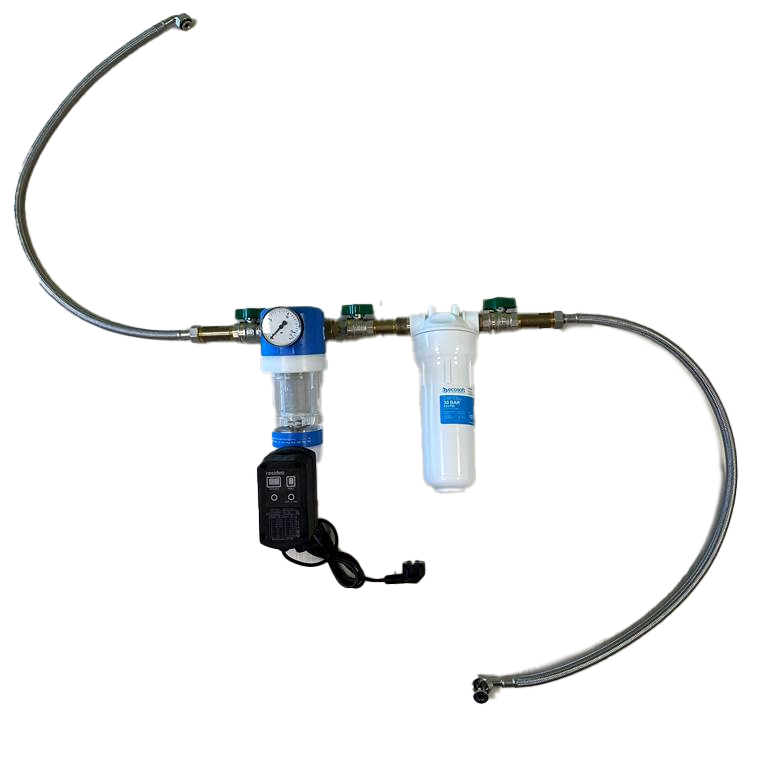
The pre-filter section is a filter unit consisting of a pre-filter with backwash and an activated carbon filter. It was developed for use in regions with poor water quality. Its main purpose is to protect downstream softening and osmosis systems that could be damaged by impurities in the water. Pre-filter with backwash: This filter mechanism removes coarse dirt particles and impurities from the water. The backwash technology allows the filter to be cleaned regularly, ensuring a long service life and constant performance. Activated carbon filter: The activated carbon filter removes chemical impurities, chlorine and unpleasant odours that are often found in drinking water. This additionally purifies the water and improves its quality. This pre-filter section efficiently protects your downstream systems by removing coarse particles, organic substances and chemicals. The pre-filter section is available in three different versions. Basic version Standard version Advanced version 882026 Standard version Pre-filtration consisting of an automatically operating backwash filter (backwash interval programmable) and downstream activated carbon filter. Frequently Asked Questions What is the standard pre-filter system used for? It protects downstream water softeners and reverse osmosis systems from contaminants in the water. What components make up the standard version? An automatic backwash filter and a downstream activated carbon filter. What is the role of the backwash filter? It removes coarse dirt particles and cleans itself automatically on a regular basis through backwashing. What is the function of the activated carbon filter? The activated carbon filter removes chemical contaminants, chlorine and unpleasant odours that are often found in drinking water. How is the service life of the pre-filter ensured? The backwash technology allows the filter to be cleaned regularly, ensuring a long service life and consistent performance. Why is the pre-filter stage important for systems? It prevents damage to sensitive downstream systems such as reverse osmosis units. This filter mechanism removes coarse dirt particles and impurities from the water.

The pressure booster line for under-sink systems has the task of providing the required amount of water at sufficient pressure for the connected consumers. These consumers include container washing systems, cleaning and disinfection devices and sterilisers. Boosting the pressure ensures that these devices are constantly supplied with the required amount of water, while at the same time optimising the pressure ratios to meet the demand. Another important aspect of the pressure booster line is the circulation of the treated water. If no demineralised water is withdrawn by the appliances, the treated water is returned from the tank and fed to the mixing bed. This continuous circulation prevents contamination of the demineralised water, as it is always in motion and cannot stagnate. This means that the high water quality is always guaranteed. The standard version of the pressure booster station consists of a 100 litre round tank with a water lock and a sterile filter. Replenishment of the demineralised water is ensured by an integrated fill level sensor. If the fill level falls below the defined minimum fill level, demineralised water production starts automatically and is stopped when the set maximum fill level is reached. Larger tank volumes are available on request.

The pressure booster line for under-sink systems has the task of providing the required amount of water at sufficient pressure for the connected consumers. These consumers include container washing systems, cleaning and disinfection devices and sterilisers. Boosting the pressure ensures that these devices are constantly supplied with the required water, while at the same time optimising the pressure ratios to meet the demand. Another important aspect of the pressure booster line is the circulation of the treated water. If no demineralised water is withdrawn by the appliances, the treated water is returned from the tank and fed to the mixing bed. This continuous circulation prevents contamination of the demineralised water, as it is always in motion and cannot stagnate. This means that the high water quality is always guaranteed. The standard version of the pressure booster station consists of a 60 litre round tank with a water lock and a sterile filter. Replenishment of the demineralised water is ensured by an integrated fill level sensor. If the fill level falls below the defined minimum fill level, demineralised water production starts automatically and is stopped when the set maximum fill level is reached. Larger tank volumes are available on request.

Pyrogen filter A pyrogen filter is a special type of filter used in water treatment to remove pyrogens from the water. Pyrogens are substances that can cause an immunological reaction in the body, in particular an increase in body temperature. These are usually endotoxins released by bacteria such as Escherichia coli (E. coli). The pyrogen filter consists of a filter element with a very fine pore size and an associated filter housing. The pyrogen filter is available with filter elements of 0.05, 0.1 or 0.2 micrometres, which you can select as required. This enables the filter to effectively retain particles and microorganisms, including pyrogenic bacteria that may be present in the water. In the modular water treatment plant, the pyrogen filter is used after other pre-treatment stages such as filtration and disinfection. After the water has been purified of particles and microorganisms, it is passed through a pyrogen filter to remove any pyrogens. Pyrogen filters are particularly important in industries where pyrogen-free water is crucial, such as in outpatient care, to ensure the optimal quality of surgical instruments. Overall, pyrogen filters play an important role in water treatment to ensure the quality and purity of the water and minimise potential exposure to pyrogenic substances.

M22 female quick coupling adapter (internal thread), with water stop for the terminal water filters for taps. Adapter for taps with an internal M22 male thread on the water outlet. This adapter is suitable for taps that have a spout with an M22 external thread that is offset inwards. It serves as an extension and moves the thread to the outside so that it is easily accessible and the water filter for taps can be connected without any problems.

Quick coupling adapter M24 AG (male thread), with water stop for the terminal water filters for taps. Adapter for connecting a water filter. Adapter for taps with an M24 female thread on the water outlet. This adapter is suitable for taps that have an outlet with a 24 female thread. This means that our water filters for taps can be easily attached to the tap.

Proposed use: for the regeneration of water softeners Composition: evaporated salt (min. 99.9% NaCl) Dimensions / weight of tablet: ø25mm / 14g Moisture content: < 0.08 Filling weight: 10kg per sack Type of packaging: PE film Storage description: store dry and well closed Certifications: ISO 9001, ISO 14001 and IFS Standard: The product complies with the following standards. EN 973:2009 Products for the treatment of water intended for human consumption - Sodium chloride for regenerating ion exchange resins -Type A EN 16401:2013 Products for the treatment of swimming pool water - Sodium chloride for use in electrochemical chlorine production plants - Type A EN 14805:2022 Products for the treatment of water intended for human consumption - Sodium chloride for on-site electrochemical production of chlorine by membrane-free processes - Type 1 EN 16370:2022 Products for the treatment of water intended for human consumption - Sodium chloride for the on-site electrochemical production of chlorine by means of membrane cells - Quality 2 Purchase options: Single purchase: 1x 10kg sack (Art.-No. 896467) Pallet purchase: 100x 10kg sacks (Art.-No. 896498) Frequently Asked Questions What are the salt tablets used for? To regenerate water softening systems whilst they are in operation. What is the quality of the salt? It consists of high-purity evaporated salt containing at least 99.9% sodium chloride. In what packaging is it supplied? In a handy 10 kg bag made of PE film. How should the product be stored? In a dry place and kept tightly sealed. Which standards does the salt meet? It complies with several EN standards for water treatment and chlorine generation. What certifications are available? ISO 9001, ISO 14001 and IFS for tested quality and safety. What applications is the product suitable for? For water softening as well as technical and hygiene-sensitive applications. What is the advantage of the 10 kg pack? It is easy to handle and ideal for smaller consumption volumes.

Proposed use: for the regeneration of water softeners Composition: evaporated salt (min. 99.9% NaCl) Dimensions / weight of tablet: ø25mm / 14g Moisture content: < 0.08 Filling weight: 25kg per sack Type of packaging: PE film Storage description: store dry and well closed Certifications: ISO 9001, ISO 14001 and IFS Standard: The product complies with the following standards... EN 973:2009 Products for the treatment of water intended for human consumption - Sodium chloride for regenerating ion exchange resins -Type A EN 16401:2013 Products for the treatment of swimming pool water - Sodium chloride for use in electrochemical chlorine production plants - Type A EN 14805:2022 Products for the treatment of water intended for human consumption - Sodium chloride for on-site electrochemical production of chlorine by membrane-free processes - Type 1 EN 16370:2022 Products for the treatment of water intended for human consumption - Sodium chloride for the on-site electrochemical production of chlorine by means of membrane cells - Quality 2 Purchase options: Single purchase: 1x 25kg sack (Art.-No. 896468) Pallet purchase: 40x 25kg sacks - 1000 kg (Art.-No. 896500) Frequently Asked Questions What are the salt tablets used for? For regenerating water softening systems. What exactly is the quality of the salt? It consists of high-purity evaporated salt containing at least 99.9% sodium chloride. In what packaging is the product supplied? In 25 kg bags made of protective PE film. How should the salt be stored? In a dry place and kept tightly sealed. Which standards does the product meet? It complies with several EN standards for water treatment and chlorine generation. What certifications are available? ISO 9001, ISO 14001 and IFS for verified quality and safety. For which applications is this salt suitable? For water softeners and technical water treatment systems. What distinguishes this variant from larger containers? It is designed as a more manageable unit for more flexible use.

Our Neomeris Select high temperature conductivity cells are suitable in a wide range of high performance applications with high temperatures and pressures.To meet these demanding technical requirements, our sensors are manufactured from 316 stainless steel with PEEK elements and feature a one-piece cell design suitable for high pressure conditions. The conductivity cells are available with different cell constants (0.1/cm and 1.0/cm) and temperature sensors (PT100 and PT1000) and are designed for a specific pressure-temperature range. Certain model types also allow you to choose between a short and long thread, depending on the installation situation.Our 1/2" inch Select LF stainless steel conductivity cell is a general purpose sensor that can be used in a variety of standard applications such as in cooling towers or water treatment plants, etc. and is easy to install. In contrast, our Select HTLF Ultra high performance conductivity cell is the top of the range model. This conductivity sensor is specially designed for boiler applications where it is permanently integrated in the boiler. Via our selection menu you can easily choose the right conductivity sensor for your application. Please contact us if you have any questions.

Our Neomeris Select high temperature conductivity cells are suitable in a wide range of high performance applications with high temperatures and pressures.To meet these demanding technical requirements, our sensors are manufactured from 316 stainless steel with PEEK elements and feature a one-piece cell design suitable for high pressure conditions. The conductivity cells are available with different cell constants (0.1/cm and 1.0/cm) and temperature sensors (PT100 and PT1000) and are designed for a specific pressure-temperature range. Certain model types also allow you to choose between a short and long thread, depending on the installation situation.Our 1/2" inch Select LF stainless steel conductivity cell is a general purpose sensor that can be used in a variety of standard applications such as in cooling towers or water treatment plants, etc. and is easy to install. In contrast, our Select HTLF Ultra high performance conductivity cell is the top of the range model. This conductivity sensor is specially designed for boiler applications where it is permanently integrated in the boiler. Via our selection menu you can easily choose the right conductivity sensor for your application. Please contact us if you have any questions.

Our Neomeris Select high temperature conductivity cells are suitable in a wide range of high performance applications with high temperatures and pressures.To meet these demanding technical requirements, our sensors are manufactured from 316 stainless steel with PEEK elements and feature a one-piece cell design suitable for high pressure conditions. The conductivity cells are available with different cell constants (0.1/cm and 1.0/cm) and temperature sensors (PT100 and PT1000) and are designed for a specific pressure-temperature range. Certain model types also allow you to choose between a short and long thread, depending on the installation situation.Our 1/2" inch Select LF stainless steel conductivity cell is a general purpose sensor that can be used in a variety of standard applications such as in cooling towers or water treatment plants, etc. and is easy to install. In contrast, our Select HTLF Ultra high performance conductivity cell is the top of the range model. This conductivity sensor is specially designed for boiler applications where it is permanently integrated in the boiler. Via our selection menu you can easily choose the right conductivity sensor for your application. Please contact us if you have any questions.